
A practical guide to no-overhead harnesses for dogs who duck, hide, or back away during gear-up, including design, fit, and calm introduction tips.
If your dog dislikes harnesses going over their head, look for a design that opens at both the neck and body so you can buckle it around the dog instead. That removes the need to pull a loop past the nose, eyes, ears, and head. It can make gear-up simpler for a head-shy dog, but it is not a treatment for fear, a substitute for a proper fit, or a guarantee that every dog will accept the harness.
I also pay attention to when the resistance started. If a dog suddenly backs away from gear they previously wore comfortably, or if they flinch when their neck, shoulders, ears, legs, or back are touched, I start with a veterinary check. Pain, skin irritation, an ear problem, or another physical issue can look like a training problem from the outside.
When pain has been ruled out, my goal is not to catch, corner, or outsmart the dog. I choose an easier design, slow down the routine, and use rewards while watching the dog's body language. The best harness in the cupboard is not useful if getting it on becomes a daily struggle.
First, work out which part your dog dislikes
A dog can love the walk and still dislike putting on the equipment. Those two things are not contradictory. The walk may be rewarding while the few seconds of reaching, touching, lifting, buckling, or tightening feel uncomfortable or worrying.
I break the routine into small pieces before deciding that the whole harness is the problem. This table is a starting point, not a diagnosis.
| What I notice | What it may tell me | My next step |
|---|---|---|
| The dog ducks only when the neck loop approaches | The overhead motion or contact around the ears may be difficult | Try a neck-buckle or fully opening harness and introduce it gradually |
| The dog backs away as soon as the harness appears | The sight of the harness may already predict an unpleasant routine | Pause the chase and rebuild a calm association at a comfortable distance |
| The dog startles at the click | The buckle sound may be part of the trigger | Practise quiet buckle sounds away from the body and pair them with rewards |
| The dog resists lifting a paw or having a leg guided | A traditional step-in routine may still be difficult | Choose a harness that opens fully without requiring paw placement |
| The reaction is sudden, painful, or happens with other touch | Discomfort or a medical issue may be involved | Stop forcing the gear and speak with a veterinarian |
Fear signals can be subtle. I watch for leaning away, a lowered body, pinned ears, lip licking, yawning, panting when it is not hot, a tucked tail, showing the whites of the eyes, freezing, or leaving the room. A dog who stays still is not automatically comfortable.
What is a dog harness that doesn't go over the head?
A no-overhead harness has an opening at the neck rather than a fixed neck loop. You place the harness against or around the dog's body, then close the neck and body buckles. Nothing needs to slide over the face or brush the ears.
That is different from a broad product label such as "step-in harness." Some step-in designs sit on the floor and require the dog to place both front paws into openings. That can work beautifully for one dog and be completely wrong for another who dislikes paw handling. Other harnesses open at several points and can be wrapped around a standing dog without going over the head or lifting a leg.
The live HNTR 3.0 Dog Harness is the second kind. It has four dual-release buckles, including buckles that let the neck section open, plus four adjustable sides. Its padded body and front and back leash attachment points are useful features to consider, but the four-buckle construction is the key feature for this specific question.
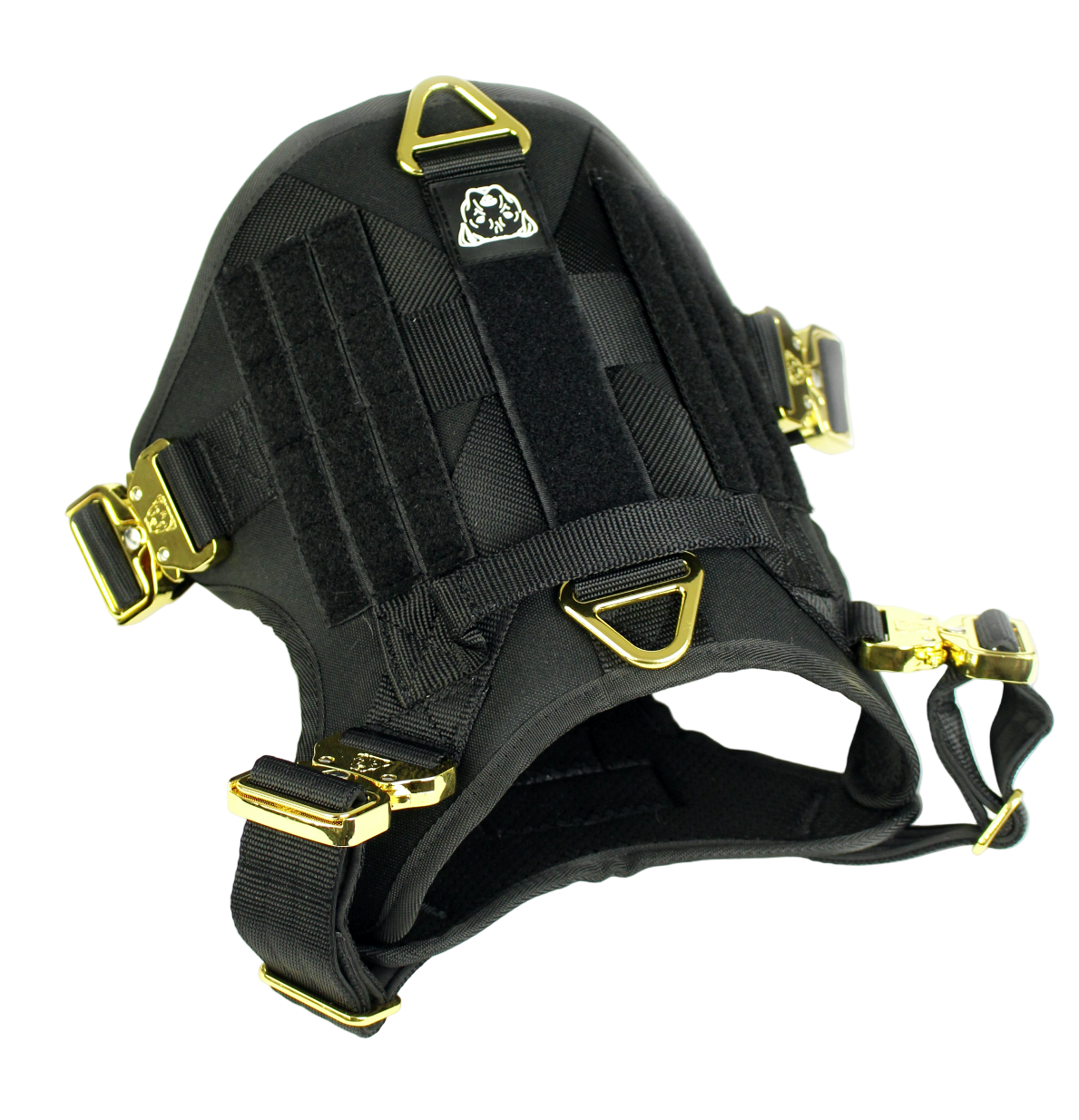
I do not describe any harness as fear-proof, escape-proof, or automatically comfortable. A design only changes how the equipment goes on. The dog's response, measurements, strap placement, condition of the gear, and introduction process still matter.
My no-overhead harness checklist
The neck opening actually unbuckles
I confirm that the neck loop opens completely. A side buckle at the chest is not enough if the fixed neck still has to pass over the dog's head. Product photos can be confusing, so I look for a clear buckle count and an explanation of how the harness is put on.
The dog does not have to lift a paw
For a dog who dislikes both overhead handling and leg handling, I want a harness that can open around the standing dog. If the dog is happy to step into a harness, a traditional step-in style may be perfectly reasonable. The useful feature is the one that removes the difficult motion for that individual dog.
There is useful adjustment on both sides
A buckle solves the overhead problem only if the rest of the harness can be fitted correctly. I look for adjustment that lets the chest panel sit centred, keeps straps flat, and prevents the harness from twisting or hanging loosely. Before ordering, I use the current Alpine Dog Co. size guide rather than guessing from breed or weight.
Padding does not hide a poor fit
Padding can feel pleasant and help reduce rough edges against the coat, but more padding is not a licence to overtighten straps. I check the edges, seams, and contact points after short early sessions. Redness, hair loss, rubbing, a change in gait, or repeated scratching means I stop and reassess.
The buckles are easy for the handler to use calmly
Four buckles add flexibility, but they also add four closures to position and check. I practise opening and closing them before the harness approaches the dog. A smooth routine is easier than fumbling while the dog waits. I also inspect every buckle, strap, and attachment point before a walk.
How I introduce the harness without forcing it
I keep this work separate from the pressure of needing to leave immediately. A quiet room, a few high-value rewards, and a very short session give the dog a better chance to stay comfortable.
1. Start with the harness at a distance
I place the harness far enough away that the dog can notice it without hiding, freezing, or refusing food. I reward calm attention, then put the harness away. If the dog will not eat a normally valued treat, I treat that as information that I may be too close or moving too quickly.
2. Let the dog approach instead of advancing on them
I sit or turn slightly sideways and allow the dog to choose whether to come closer. I do not block an exit or follow the dog around furniture. The goal is to make the harness predictable, not inescapable.
3. Break the routine into one small action
One session might be touching the shoulder briefly with a strap. Another might be resting the open chest piece in position for one second. I reward, release, and stop before stacking every buckle into the same attempt.
4. Introduce buckle sounds separately
If the click causes a startle, I close a buckle away from the dog at a low intensity, give a reward, and pause. I do not snap hardware repeatedly beside the ears. Progress means the dog stays loose and engaged, not merely that I managed to finish the task.
5. Buckle around the dog, one section at a time
Once the dog is comfortable with the open harness touching the body, I close one easy buckle, reward, and remove it. Over several comfortable sessions, I build toward the full routine. A no-overhead design helps here because I can keep the neck section open until it is already in place.
6. Keep early wear brief
At first, I let the dog wear the fitted harness for a short, calm activity, then remove it before irritation or worry appears. I do not leave a new harness on unsupervised. After movement, I recheck the straps because a fit that looks fine while standing can shift during a walk.
AVSAB and the BC SPCA recommend reward-based, force-free methods. If a dog is panicking, snapping, guarding their body, or unable to stay comfortable at the earliest step, I pause and ask a veterinarian or qualified reward-based behaviour professional for an individual plan.
Fit still matters after the easy gear-up
A harness that goes on calmly can still be the wrong size. I follow the manufacturer's measurement instructions, centre the chest panel, make sure the straps lie flat, and check that the hardware is not sitting in an armpit or pressing into soft tissue.
I watch the dog walk, turn, sit, and lower their head. The harness should not twist dramatically, gap away from the body, restrict normal movement, or rub with each stride. Our detailed guide to getting the right harness fit covers those checks more fully.
Fit needs to be checked again as a puppy grows, a dog's weight or coat changes, or straps settle with use. I also inspect stitching, webbing, buckles, and leash points regularly. A no-overhead design does not make worn or damaged equipment safe to keep using.
When changing the harness design is not enough
A neck buckle removes one possible trigger. It will not help every dog. Some dogs dislike the sound of hardware, pressure around the body, paw handling, being approached, or the anticipation created by a long history of being chased and caught.
I take sudden avoidance seriously, especially when it appears alongside stiffness, skin changes, ear sensitivity, limping, reluctance to jump, or discomfort with touch. That is a veterinary conversation before it is a shopping decision.
I also avoid using the new harness as a test of who can win. Forcing it on may get one walk started, but it can strengthen the prediction that the harness means restraint. A temporary walking and safety plan should be made with a qualified professional who understands the dog, the environment, and the reason the harness is needed.
Why I would consider the HNTR 3.0 for this job
The reason is specific: the HNTR 3.0 has four buckles and does not need to pass over the head. Its four adjustable sides also give me more places to refine the fit than a simple fixed vest. The padded body and multiple leash attachment points may suit other needs, but they do not replace training or measurement.
The current HNTR harness collection shows the available options. I avoid choosing by colour first. I start with measurements, the dog's handling preferences, and whether I can operate every buckle smoothly.
I also keep my claims realistic. A front attachment point does not teach loose-leash walking by itself. Four buckles do not make a harness impossible to back out of. Padding does not prevent every rub. The product can solve the mechanical problem of passing a harness over the head, and that is useful enough without promising more.
Frequently asked questions
Why does my dog hide from the harness but love the walk?
The dog may enjoy being outside while disliking one part of getting ready. The overhead motion, ear contact, buckle sound, leg handling, fit, or the way a person approaches can become the difficult cue. Watch the sequence closely instead of assuming the walk itself is unwanted.
Is a step-in harness the same as a harness that doesn't go over the head?
Not always. Step-in harnesses avoid the head, but many require the dog to place or lift the front paws. A fully opening harness can buckle around the neck and body without a head pass or a step-in motion. Check the actual buckle layout rather than relying only on the product category.
Can a no-overhead harness stop my dog from pulling?
No harness design teaches loose-leash walking on its own. Attachment points can change handling mechanics, but training, fit, the dog's comfort, and the walking environment still matter. Avoid any promise that equipment alone will stop pulling.
Is a four-buckle harness escape-proof?
No. I do not call any harness escape-proof. Correct measurements, strap adjustment, regular condition checks, calm handling, and an appropriate safety plan all matter. Dogs with a history of backing out need individual advice and close supervision.
What if my dog is afraid of the buckle sound?
Introduce the sound at a comfortable distance and pair a quiet click with something the dog values. Do not repeatedly snap buckles beside the dog's ears. If the dog cannot stay relaxed, get help from a qualified reward-based professional.
What if my dog suddenly refuses a harness they used to wear?
Stop forcing it and arrange a veterinary check, especially if there are other changes in movement, touch tolerance, skin, ears, or behaviour. A new avoidance can reflect discomfort, and changing products should not delay that assessment.
My final answer
For a dog who dislikes equipment going over the head, I look for a harness with a neck buckle and body buckles that let it open fully. That removes the face and ear pass and may make the routine much easier. I still measure carefully, check movement and contact points, inspect the gear, and introduce it in short reward-based steps.
The HNTR 3.0 fits this narrow need because its four-buckle construction lets it close around the dog instead of sliding over the head. It is a useful design choice, not a cure for fear or a safety guarantee. If the aversion is sudden, painful, intense, or extends to other handling, I involve a veterinarian and a qualified reward-based professional.

Natalie McCalla
Natalie is the co-owner of Alpine Dog Co. and a mom of two who shares life with two bully breeds. After her American Bulldog, Bam Bam, kept escaping collars, she began designing durable, personalized gear for dogs who need strength without sacrificing style, safety, or comfort. Natalie writes for dog owners who want practical, real-world guidance and products that fit their dog’s personality.