

An AirTag is not GPS. Here is how the Find My network works, where the Terrain harness pocket fits, and the trail-safety layers I still use.
An AirTag for dogs can add a useful clue if a dog gets separated from you, but it is not a GPS tracker and it does not provide guaranteed live locations. AirTag uses Bluetooth and Apple's Find My network. Away from your phone, its location depends on a nearby participating Apple device detecting it. On a quiet trail with few people and phones, an update may arrive late or not at all.
That is why I treat an AirTag as one recovery layer, not as permission to relax the rest of the plan. A leash that follows local rules, a visible ID tag, a registered microchip with current contact details, practiced recall, and a shared route plan still do the heavier safety work. Apple also says AirTag is made to help find belongings, not people or pets.
The hidden pocket in our Terrain harness has a simple job: keep a separately purchased AirTag secured, discreet, and out of the way while the harness is worn. It cannot turn the AirTag into GPS, prevent a dog from getting loose, or guarantee a recovery. Here is how I decide whether that setup makes sense for a hike.
How an AirTag location actually reaches you
AirTag uses Bluetooth for proximity and Find My network detection. When it is near your paired Apple device, the Find My app can help you locate it or play a sound. On compatible Apple hardware, Ultra Wideband powers Precision Finding for close-range directions.
When the AirTag is farther away, it does not send its own location through a cellular network. Instead, a nearby device participating in the Find My network can detect the Bluetooth signal and relay an approximate location to the owner. Apple designs that exchange to be anonymous and encrypted.
This distinction matters outdoors. A busy urban trailhead may have plenty of passing devices. A remote forest road may have none for long stretches. The AirTag might appear at a last known location, update only after another hiker passes, or remain unavailable while you actively search. I never read a motionless Find My map as proof that the dog is still standing on that spot.
What happens when someone finds the AirTag
In Lost Mode, you can add contact information for a finder. A person with an NFC-capable phone, including many Android phones, can tap the AirTag and view the lost message you chose to share. That can help if the finder has the dog or the harness in hand.
Android support does not mean an Android owner gets the full AirTag experience. Pairing, owner tracking, and Find My features are built around Apple's ecosystem. If your household does not use compatible Apple hardware, compare other recovery tools before choosing an AirTag.
Where an AirTag may help and where it may fall short
| Situation | What an AirTag may add | Important limit |
|---|---|---|
| Dog is close but hidden by brush | Nearby finding tools or a sound may help narrow the search | Range, terrain, battery, noise, and compatible hardware affect the result |
| Dog reaches a populated area | A passing Find My network device may relay an approximate location | The update is not guaranteed or continuous |
| A person finds the dog | Lost Mode contact details may be available by tapping the AirTag | A visible ID tag is faster and more obvious to many finders |
| Dog is on a sparsely travelled trail | A later detection may provide a useful clue | There may be no nearby network device when you need an update |
| Harness comes off | Find My may help locate the harness and AirTag | That location no longer represents the dog |
The final row is easy to overlook. Every wearable tracker reports the location of the device, not the dog as a biological certainty. Fit, pocket closure, and regular gear checks matter because a separated harness can send your search in the wrong direction.
AirTag, GPS tracker, ID tag, and microchip are different tools
I like to give each layer one clear job. That keeps the convenience of an app from replacing simpler identification and control measures.
| Tool | Best contribution | What it does not do |
|---|---|---|
| AirTag | Find My detections, nearby finding, sound, and a Lost Mode message | Provide dedicated cellular GPS tracking or guaranteed trail coverage |
| GPS dog tracker | Potentially more frequent location updates through its own service | Eliminate coverage gaps, charging, subscriptions, device loss, or app limits |
| Visible ID tag | Give a finder an immediate way to call or text | Transmit a location or stay useful if unreadable or detached |
| Registered microchip | Provide permanent identification when a clinic or shelter scans it | Act as GPS or help if registration details are outdated |
| Leash and trained recall | Reduce the chance of separation and help regain control | Replace identification or make every situation predictable |
If frequent remote location updates are the priority, I would compare dedicated GPS dog trackers rather than asking an AirTag to do that job. Check the tracker's map coverage, cellular requirements, update intervals, battery life, subscription, size, attachment, and water-resistance instructions. "GPS" by itself is not a promise that every valley, forest, or back road has service.
What the Terrain harness pocket contributes
The Terrain Dog Harness in black has a concealed chest pocket lined with thick hook-and-loop material. The pocket is designed to secure an Apple AirTag without advertising that a tag holder is present. You supply and set up the AirTag separately.
The harness itself is a lightweight, more breathable alternative to a standard tactical-style harness. It has neoprene lining, a padded chest, adjustable shoulder, chest, and stomach sections, welded hardware, two chest quick-release buckles, and a functional handle. Other colours and sizes are available in the Terrain harness collection.
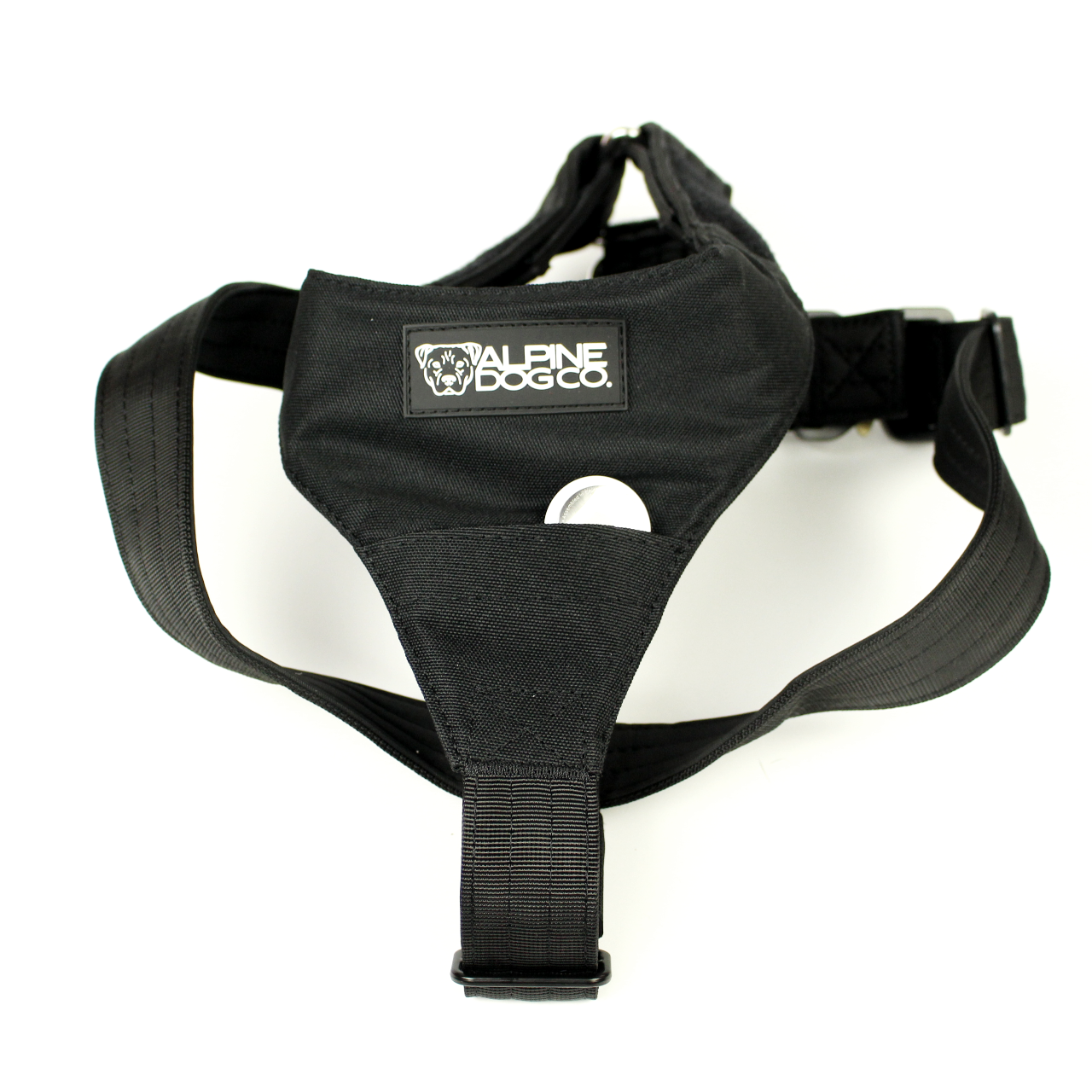
I see the hidden pocket as organization and retention, not an upgrade to the AirTag's technology. It keeps the device in a purpose-built spot instead of leaving a loose holder to swing from a ring. The AirTag still has the same network, battery, range, and water-resistance limits it would have elsewhere.
My fit and retention check
Before a longer outing, I slip the harness over the dog's head, fasten both chest buckles, and adjust all three areas. The fit should be secure without pressing on the throat, restricting shoulder movement, pinching skin, or sliding around the body. Our shoulder hook-and-loop needs at least 3.5 inches of contact and should never be opened to its absolute end.
I then confirm that the AirTag is seated inside the pocket, the inner material is fully engaged, and no grit, hair, or fabric fold is weakening the closure. After the dog walks, sits, turns, and shakes, I check again. The full dog harness fit guide is worth reviewing whenever a dog's measurements or coat changes.
No fit stays correct forever. I inspect the webbing, stitching, hardware, buckles, pocket, and device before each hike and after rough play or washing. Damaged gear gets replaced rather than tested on the trail.
My pre-hike AirTag and safety checklist
- Set up Find My before leaving. Confirm that the AirTag appears under Items, review its name, and test the nearby sound or finding feature at home.
- Check the battery status. The battery is replaceable, but I do not wait for a trail day to discover that it needs attention.
- Update the recovery details. Keep the visible ID tag and microchip registration current, and know which phone number or email you will enter if you need to turn on Show Contact Info for the AirTag.
- Inspect the pocket and harness. Seat the AirTag, close the pocket completely, check the fit, and look for wear or debris.
- Follow the trail's leash rules. Wildlife, cliffs, bikes, horses, other dogs, and sudden noises can change a calm walk quickly.
- Prepare the dog, not just the device. Practice recall in controlled settings, build distance gradually, and choose a route suited to the dog's health, fitness, age, and experience.
- Pack for the actual conditions. Bring water, a bowl, waste bags, weather protection, a pet first aid kit, and any dog-specific supplies.
- Share the plan. Tell someone the route, trailhead, expected return time, vehicle details, and what to do if you miss the check-in.
I also save important phone numbers and download the route before entering unreliable service. A nearby Find My network device may still detect the AirTag while my phone is offline, but I need an internet connection to receive a fresh location and coordinate the search.
If the dog gets loose
I would open Find My and use any current or last known location as one clue, not the whole search. I would mark the AirTag as lost, enter the contact message, note the time of the last update, and keep checking periodically without letting the screen replace a safe, organized search.
At the same time, I would contact local animal services, shelters, veterinary clinics, park staff, and the microchip registry; alert people near the last confirmed location; and organize calm help. A frightened dog may behave differently than usual, so I would follow current instructions from local animal services or a qualified lost-pet professional. Our lost-dog prevention and response plan covers the wider checklist.
If the map updates, record the time and location. A new Find My detection can narrow the search, but it may reflect the AirTag, the harness, or a delay in the network. I would keep every other recovery channel active until the dog is physically safe.
Frequently asked questions
Will an AirTag work in the woods?
It may, but not like a live GPS tracker. Nearby finding can help within range. Farther away, a location depends on a participating Find My network device passing close enough to detect the AirTag. Sparse trails can produce delayed updates or no update.
Can I track my dog in real time with an AirTag?
No. AirTag does not provide the dedicated cellular location stream people normally mean by real-time dog tracking. Find My locations can be useful clues, but their timing and availability vary.
Is an AirTag better than a GPS dog tracker?
They solve different problems. AirTag is a small Find My accessory with a replaceable battery and no separate tracking subscription. A dedicated GPS dog tracker may offer more frequent remote updates, but you still need to compare service coverage, charging, cost, attachment, and app performance.
Does the Terrain harness include an AirTag?
No. The hidden pocket is designed to hold an Apple AirTag, but the AirTag is purchased and set up separately.
Can an AirTag replace a leash, ID tag, or microchip?
No. A leash helps prevent separation, an ID tag helps a finder contact you immediately, and a registered microchip provides permanent identification when scanned. An AirTag can sit beside those layers, not replace them.
Is an AirTag waterproof inside the pocket?
No waterproof promise should be assumed. Apple lists AirTag water and dust resistance under controlled laboratory conditions and says that resistance is not permanent. The harness pocket is not a waterproof electronics case. Follow Apple's care instructions and inspect both items after wet or muddy outings.
Can an Android user track an AirTag?
Not with the same owner experience. AirTag setup and Find My tracking require compatible Apple hardware and an Apple account. An NFC-capable Android phone can tap a found AirTag to read a Lost Mode message, but that is different from owning and tracking it.
How often should I check the AirTag pocket?
Check it before every outing, after rough play, and after cleaning the harness. Confirm that the AirTag is seated, the closure is fully engaged, and the pocket and surrounding material are not damaged or clogged with debris.
My final answer
An AirTag for dogs is most useful when I give it a modest, specific job: add another possible clue if the harness and dog become separated from me. The Terrain harness pocket keeps that device secured and discreet, but it cannot create network coverage or turn Bluetooth into GPS.
For a hike, I would still lead with a well-fitted harness, a leash that follows trail rules, a visible ID tag, a current microchip registration, practiced recall, and a route suited to the dog. If I need frequent remote updates, I would compare dedicated GPS dog trackers. Honest expectations make every tool more useful.
Useful sources
- Apple: New AirTag and how the Find My network helps locate belongings
- Apple Support: Use AirTag and Find My to keep track of personal items
- Apple Support: AirTag technical specifications
- Apple Support: Mark an item as lost in Find My
- Parks Canada: Hiking safety
- Ontario SPCA: Why microchip?

Natalie McCalla
Natalie is the co-owner of Alpine Dog Co. and a mom of two who shares life with two bully breeds. After her American Bulldog, Bam Bam, kept escaping collars, she began designing durable, personalized gear for dogs who need strength without sacrificing style, safety, or comfort. Natalie writes for dog owners who want practical, real-world guidance and products that fit their dog’s personality.